


Virendra Pandit
New Delhi: The European Parliament (EP)’s recent resolution on forced labor and the condition of the Uyghurs in the Xinjiang Uyghur Autonomous Region (XUAR) has jeopardized China’s plans to sign investment deals with the European Union (EU) member-states.
The EP’s December 18 resolution came soon after media reports surfaced that about half-a-million Uighur Muslims and other minorities in Xinjiang province of China have been forced to pick cotton by hand.
“Labour rights in China is a hot potato, particularly given the parliament’s recent urgent resolution on Xinjiang. If there are no proper commitments on the International Labour Organisation, then it will be extremely difficult,” South China Morning Post (SCMP) reported.
The EP resolution on forced labor and the condition of the Uyghurs in the XUAR called on the EU to proactively work towards an independent UN inquiry on China and ensure accountability for the crimes committed.
“The situation in Xinjiang, where more than 10 million Muslim Uyghurs and Kazakhs live, has rapidly deteriorated, particularly since the launch of the Chinese Government’s ‘Strike Hard against Violent Terrorism’ campaign in 2014”, said the EP resolution.
“Uyghurs and other primarily Muslim ethnic minorities in the Xinjiang Uyghur Autonomous Region have been subjected to arbitrary detention, torture, egregious restrictions on religious practice and culture, and a digitalized surveillance system so pervasive that every aspect of daily life is monitored — through facial recognition cameras, mobile phone scans, the large-scale illegal collection, aggregation and processing of personal data”.
China has strengthened its regime and toughened the treatment of minorities, in particular of Uyghurs, Tibetans, and Mongolians, with the aim of assimilating them through the imposition of the Chinese majority lifestyle and communist ideology, the resolution said.
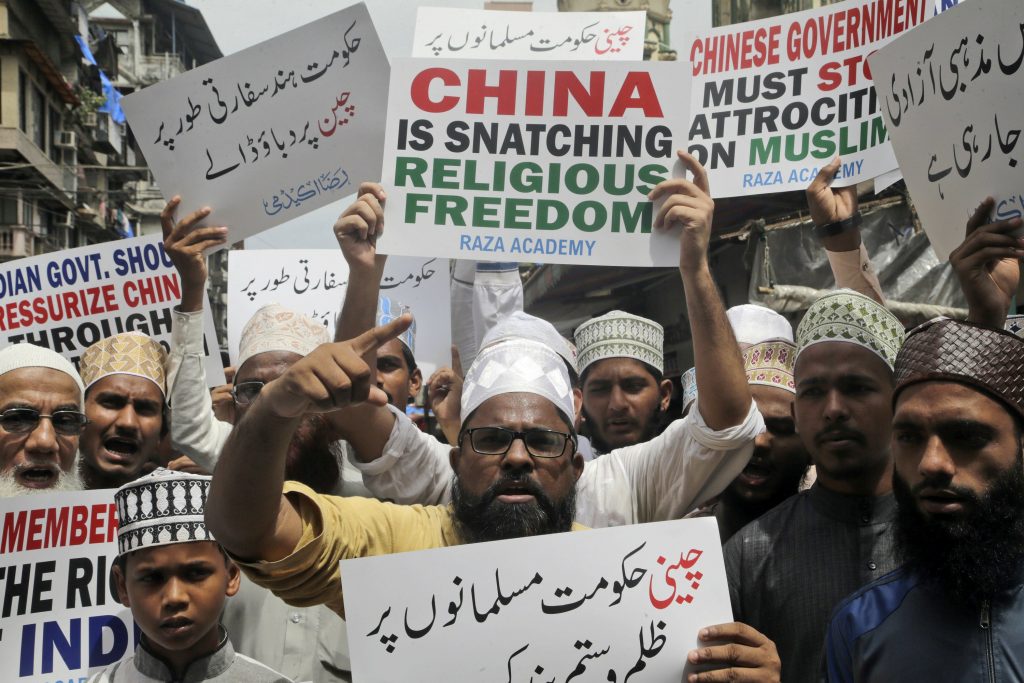
More than one million people have been detained in ‘political re-education’ centers in what is viewed as the largest mass incarceration of an ethnic minority population in the contemporary world.
The internment camp system in the XUAR is still expanding, with more than 440 detention facilities put in place.
The reports said the Chinese are systematically forcing young Uyghur women into abortions, and sterilization. So much so that 80 percent of all new intrauterine device (IUD) placements in China in 2018 were performed in the Uyghur region alone.
Beijing routinely denies abuse of Uighurs’ rights and claims that re-education centers provide vocational training to help people gain employment, and that these are necessary to curb extremism.
In 2018, three majority-Uighur areas within Xinjiang alone mobilized at least 570,000 people to pick cotton through the scheme, media reported, quoting a think-tank report.
Cotton-pickers are transferred in tightly supervised groups and kept under strict watch. Some areas put Uighur children and elderly people into “centralized care” while working-age adults are forced to pick cotton.
Xinjiang is a major global hub for the cotton industry, producing 85 percent of China’s and 20 percent of the world’s cotton. It relies heavily on manual labor, particularly for higher quality cotton.
Earlier, the US had called out the main cotton producer in Xinjiang, the paramilitary Xinjiang Production and Construction Corps, for using forced Uighur labor. In December, U.S. customs authorities ordered to block its cotton products from entering America.
The U.S. Congress is currently considering legislation banning all goods produced by forced labor in Xinjiang.